From the blog
Solar Installer Website Lead Attribution: The Phoenix Math (and the Solar Website Designer You Actually Need)
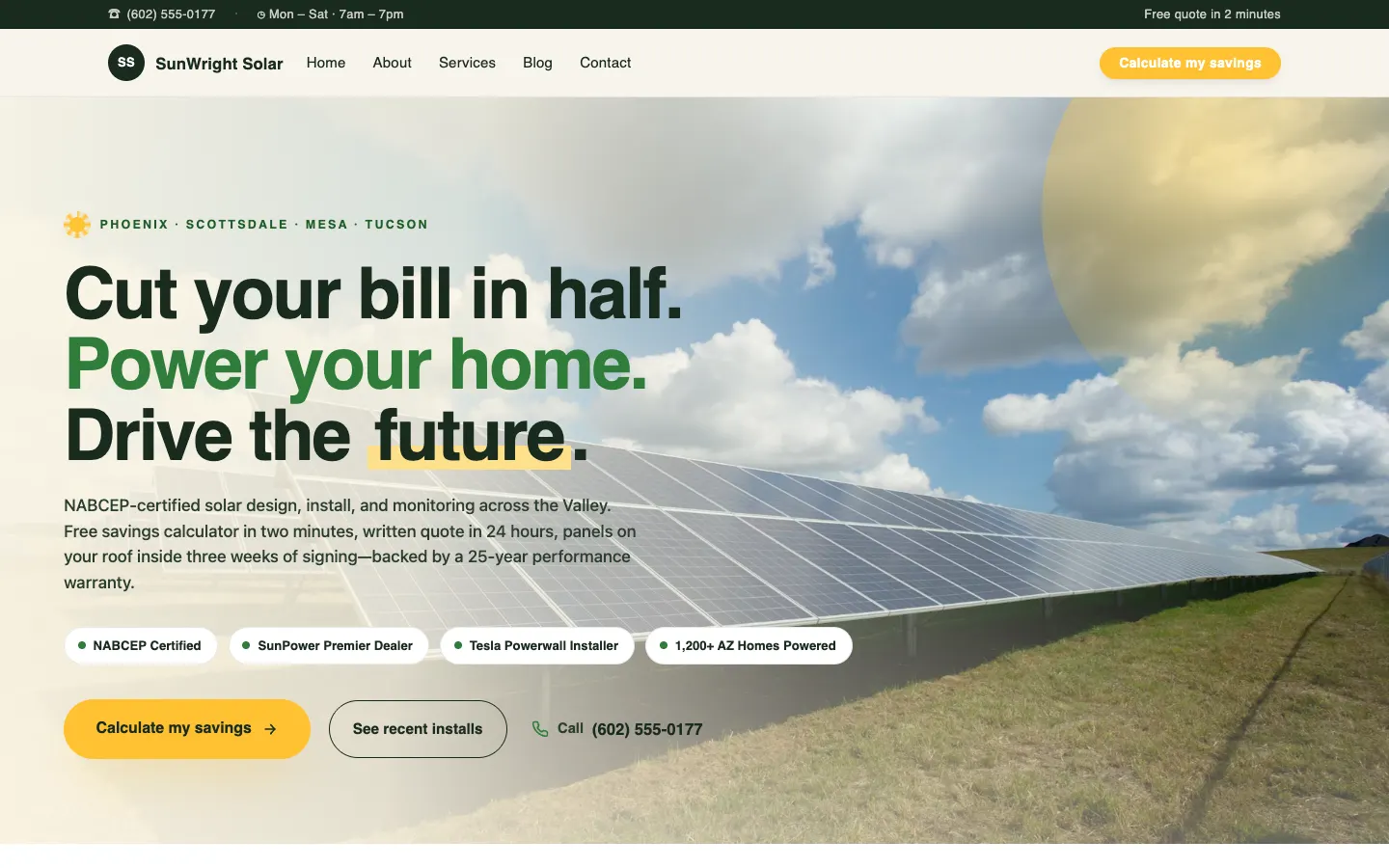
A qualified residential solar lead in Phoenix costs us between $180 and $340 through Google Ads right now, and the question of solar installer website lead attribution is the one nobody on the sales side wants to answer: which page on your site actually closed the site survey? Almost no installer we have audited can answer that. They are running a slot machine with a $20,000 monthly handle, and the partner who hands them an invoice for it every month is a solar website designer they hired in 2022 who has not touched the schema, the internal-link graph, or the LLM-citation surface since.
A 1.5 percentage-point conversion lift on a site doing 8,000 monthly visitors is worth roughly $54,000 a year in pipeline at our average net-margin-per-install. That is the prize. The route to it is a CMS that ties every form, click-to-call, and Calendly booking back to the page and the source that produced it - and a content cadence that does not depend on a freelancer responding to a Slack message on a Sunday. Book a 20-minute Workspace CMS demo for solar if you want the short version; the rest of this post is the long one.
The Phoenix solar lead is the most over-shopped lead in America
Solar buyers in APS and SRP territory do not impulse-buy a 9.6 kW rooftop array. Industry averages put residential solar consideration cycles between 6 and 14 weeks, and Phoenix runs on the longer end thanks to the 2026 APS rate restructure conversations and the lingering net billing vs. legacy NEM confusion. By the time a homeowner schedules a site survey, they have:
- Clicked at least one Google Ads result
- Compared 3 to 5 installer websites side by side
- Read an EnergySage or SolarReviews profile
- Asked ChatGPT, Claude, Perplexity, or Gemini “best solar installer Phoenix” - the second-most-common discovery path for under-45 homeowners in our sample
- Talked to a door-knocker from a national EPC
- Run kWh numbers against a PPA vs. cash-purchase ITC calculator
Then they fill out a form. The form says source: organic because that was the last touch. Your CRM, your spreadsheet, or your half-configured GA4 quietly throws away every prior step. That is why your Cost-per-Acquired-Install number is a lie - and why the partner question is not “who can build me a prettier site” but “who can give me a system that tells me which content actually closes a $32,000 install.”

What solar installer website lead attribution actually looks like in a real CMS
Most solar installer sites are stitched together: a WordPress theme bought in 2021, a form plugin, a Calendly embed, a CallRail number, maybe a Zapier pipe into HubSpot. The attribution data lives in five places and reconciles in none. The agency that built it stopped answering tickets last September.
Workspace CMS handles this differently. The platform feature set bakes attribution into the core, not a plugin you bolted on. Every form submit, click-to-call, and scheduled site survey is tagged with:
- First-touch landing page (the article or service page they actually entered on)
- Full referrer chain - Google Ads campaign, organic cluster, EnergySage referral, direct, or LLM citation
- Pages-viewed sequence before conversion (the “did they read the NEM explainer before booking” question)
- Time-to-conversion bucket
That data lands in Analytics (GA4 + GSC unified)- one screen that finally puts your Search Console ranking data and your GA4 conversion data side by side, indexed against the URL the visitor actually landed on. You stop building dashboards in three tabs. You stop arguing about which number is right. There is one number.
That is what you needed in order to answer the only question that matters at next month’s marketing meeting: which three pages produced 70 percent of our closed installs, and how do we build ten more like them?
The AEO problem nobody on your sales team is tracking
Here is what is genuinely new in 2026. When a Phoenix homeowner opens ChatGPT and types “best solar installer in Phoenix for a tile roof” or “who handles SRP solar interconnection fastest,” an answer comes back. Sometimes it names you. Sometimes it names your worst competitor and recommends them to a buyer who would have been yours.
You have no analytics tag on that conversation. There is no UTM. The homeowner arrives at your site pre-sold - or never arrives at all. This is AEO (Answer Engine Optimization) territory, and for solar specifically it is the highest-impact marketing surface available right now because the consideration window is so long. Buyers ask the LLM something, then ask again two weeks later, then ask a third time before they ever fill out a form.
The AI Visibility Tracker runs your priority prompts - “best solar installer Phoenix,” “Phoenix solar company with battery backup,” your competitor names - through ChatGPT, Claude, Perplexity, and Gemini on a schedule. You see whether your brand is being cited, how you rank against competitors, and which content the LLMs are pulling from. Essentials gives you 5 tracked prompts. Growth gives you 15. Premium gives you 30 with weekly LLM visibility digests. When a competitor edges you out on “best solar installer Phoenix tile roof,” you get a notification, not a six-week lag before you notice the lost pipeline.
Pair that with the AI Content Audit- 40+ issue detection per page, with one-click fixes for the gaps the LLMs are punishing you for - and you have a closed loop. You know what they ask. You know whether you are cited. You know what to fix. You ship the fix.
UNLIMITED MANAGED CHANGES
Send a ticket. We ship the change.
Every Workspace CMS plan includes unlimited managed CMS edits. Essentials ships in 4 business days. Growth ships in 2. Premium ships in 12–24 hours. No per-edit fees. No “open a Jira” overhead. Every APS rate-plan update, every new SRP service-area page, every battery-rebate landing page, every Phoenix-suburb microsite - describe what you need and our team builds it on your live site.
SEO and JSON-LD schema: the part Phoenix installers still skip
Local solar SEO is not generic local SEO. Google’s solar SERP rewards installers who publish technically literate content: NEM vs. net billing under APS, SRP customer-generation price plans, ITC step-down timing, microinverter vs. string-inverter tradeoffs on tile roofs in 115-degree summers. Generic “why go solar” content has not ranked in two years.
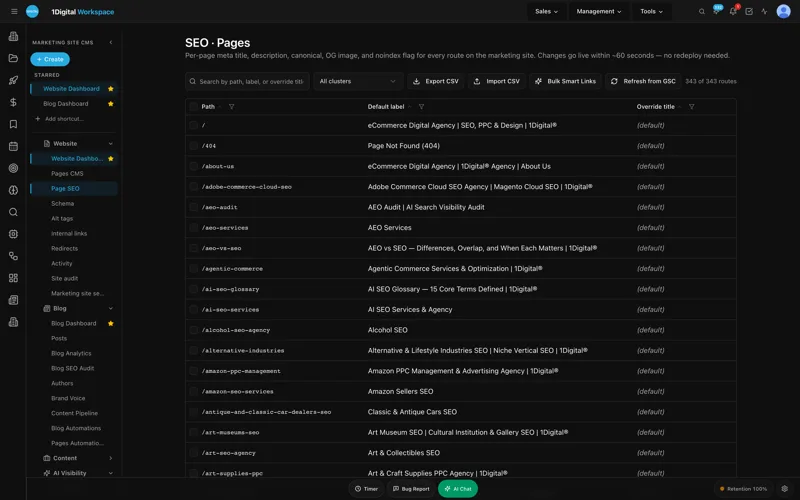
Workspace CMS gives you a Structured Data (JSON-LD) editor on every page - visual, with live validation before publish - covering Service, LocalBusiness, FAQ, and HowTo schema. That structured data is what makes ChatGPT cite you and what gets you into Google’s AI Overviews for solar queries. The Internal-Link Rules engine is anchor-text-aware, which matters when you have eighteen service-area pages (Mesa, Gilbert, Chandler, Tempe, Scottsdale, Glendale, Peoria, Surprise, Queen Creek, Maricopa, Buckeye, Avondale, Goodyear, Litchfield Park, Sun City, Sun City West, Anthem, Cave Creek) and you need each new blog post to push authority into the right one without a freelancer manually re-linking every quarter.
The Site Audit runs 40+ checks per page with one-click remediation - the kind of sweep a competent solar website designer used to charge $4,000 for, on a one-shot basis, and never re-run. Here it runs nightly. The AI Meta Rewriter auto-generates titles and descriptions for every service-area page in your brand voice, so the eighteen suburb pages do not all carry the same lazy template tag.
Choosing a solar website designer who can actually keep up
The reason we frame this around picking a solar website designer instead of just “a CMS” is that every Phoenix installer we have audited has the same underlying problem: the build was fine, the upkeep was not. Solar shops do not need a solar marketing agency that disappears for ninety days and resurfaces with an invoice. They need someone whose default response to “APS just published new export rates” is “ticket received, page updated tomorrow.”
That is the Workspace CMS managed-change model. We document the end-to-end managed-change workflow on the marketing site - ticket in, build, QA, publish, notify - and the SLAs are not aspirational. Essentials ships in 4 business days. Growth ships in 2. Premium ships in 12–24 hours. Compared to the average solar website development company, which quotes per-change and bills hourly, the math gets uncomfortable for the incumbent agency very quickly.
If you want to see what other shops in the same shoes ended up with, the live demo gallery walks through twenty-plus tenanted builds in adjacent verticals.
Which tier makes sense for a solar shop
Solar installers come in three rough shapes. Here is how the pricing maps:
- Essentials ($89/month)- owner-operator shops doing 8 to 15 installs a month. You manage your own content but get the full SEO toolset (Site Audit, Redirect Manager, Structured Data editor, llms.txt), the AI Blog Generator, the 5-prompt AI Visibility Tracker, and a 4-business-day managed-change SLA. Right answer if your marketing person is you, on Sundays.
- Growth ($199/month)- where most solar shops doing 20 to 60 installs a month land. Unlimited managed content edits with a 2-business-day SLA, Google reviews on your site (display and reply), 1,000 AI credits, the full GA4+GSC unified analytics, Internal-Link Rules, and the 15-prompt AI Visibility tracking. “Send a ticket; we ship the change” is the right model when you have sales reps who need new landing pages built around utility-specific offers in time for next week’s door-knocking territory.
- Premium ($449/month)- multi-location regional installers, EPCs, or anyone running paid spend over $25K/month. 12–24 hour change SLA, daily Site Audit, 30-prompt monthly AI Visibility tracking with LLM citation digests, and white-label admin if you are running a partner storefront. The white-glove tier.
For most shops at SunWright’s install volume, Growth is the obvious fit. The full pricing-tier comparison and feature matrix lays out every included AI credit, SLA, and feature side by side.
What changes in the first 90 days
Workspace CMS launches most solar sites in 2 weeks. After that, the typical trajectory:
- Weeks 1–2: Site live. Attribution tagged on every form, phone, and Calendly link. LocalBusiness and Service schema deployed on every location and service page through the Structured Data editor. Internal-Link Rules wired so new blog posts auto-link to the right suburb pages.
- Weeks 3–6: First unified GA4+GSC attribution report runs. You discover two pages you barely thought about (often a battery-backup explainer and a utility-specific NEM page) are responsible for a disproportionate share of booked surveys. You also kill three Google Ads campaigns producing clicks but zero conversions. Paid CPL drops 20–30 percent. AI Content Audit flags 40+ on-page issues; they get fixed in a single ticket.
- Weeks 7–12: AI Visibility Tracker shows ChatGPT now cites you for two of fifteen tracked prompts. You publish three more deep-content pages targeting the prompts you are not yet cited on, all through the AI Blog Generator drafting against your brand voice and our content desk editing them into ship-ready shape.
No page builder. No HTML. You send a ticket; the change ships. That is the difference between a solar website designer who handed you a static brochure in 2022 and a partner that keeps the site moving every week.
Solar Installer Website Lead Attribution: The Phoenix Math FAQ
Does Workspace CMS integrate with our solar CRM (Aurora, OpenSolar, HubSpot)?
Yes. Lead webhooks fire on every form submission and can post to any CRM that accepts an HTTPS endpoint. Aurora, OpenSolar, and HubSpot integrations are standard ticketed work on Growth and Premium, and the unified analytics screen shows the close-loop on each lead once your CRM posts back the disposition.
How does attribution handle door-to-door leads that come in offline?
Door-to-door reps get a personalized landing-page URL per rep, built as a ticket. The page attributes the lead to that rep and tags the source as field-sales, so you see field-sales leads alongside paid, organic, and LLM-cited leads in the same view. Reps can scan a QR code on the homeowner’s porch and trigger the form pre-filled with their rep ID.
Can the AI Blog Generator write Phoenix-specific NEM and ITC content?
Yes. You feed it your service area (APS, SRP, TEP), typical system sizes, and your differentiators (tile-roof specialists, battery-backup focus). It drafts; you or our team edits. Most Growth shops ship 4 to 6 long-form posts a month, and the Internal-Link Rules engine automatically threads them into your service-area pages.
What happens to our existing URLs if we migrate from WordPress?
The Redirect Manager with conflict detection ingests your URL map, flags 301/302/307/308 conflicts before they ship, and goes live on launch day. We have migrated solar sites with 300+ legacy URLs without losing organic traffic. The sitemap, robots.txt, and llms.txt are auto-regenerated on every publish, so the search engines and the LLMs both pick the new structure up immediately.
Is Workspace CMS overkill if we only do 6 installs a month?
At that volume Essentials at $89/month is plenty: full SEO toolset, AI Blog Generator, 5-prompt AI Visibility Tracker, 4-business-day managed-change SLA. Upgrade to Growth when install volume justifies the managed-content cadence - usually somewhere around 15–20 installs a month, when the cost of your time exceeds $110 the difference between tiers.
The bottom line for a Phoenix solar shop
Lead attribution is not a vanity metric. It is the difference between a marketing budget you can defend at the partner meeting and one that quietly funds the wrong campaigns for another quarter. If you spend $15,000 to $40,000 a month acquiring solar leads in the Valley, you cannot afford a CMS that obscures which pages close site surveys - and you cannot afford to be invisible when a homeowner asks ChatGPT “who should I get solar quotes from in Phoenix.” The right answer is not another solar marketing agency on retainer. It is a platform plus a managed-change team that ships the work weekly. Start the conversation with the Workspace CMS team and we will run your domain through the AI Visibility Tracker live on the call.